
Suppliers and manufacturers each have Consumer Guarantee obligations under the Australian Consumer Law (ACL), regardless of whether a supplier or manufacturer has provided a warranty against defects in relation to the goods. When an issue arises with a good the consumer may approach either the supplier or manufacturer of the good to seek a remedy. Additionally, the supplier has a right of indemnity against the manufacturer in some circumstances. This fact sheet provides general information on the multi-layered application of the consumer guarantees to suppliers and manufacturers and the supplier’s right of indemnity against the manufacturer.
Brief Overview of Consumer Guarantees and Warranties
The ACL provides statutory guarantees relating to the supply of goods and services to consumers (Consumer Guarantees). Both suppliers and manufacturers carry Consumer Guarantee obligations under the ACL. These are statutory guarantees available to the consumer that cannot be contracted out of.
For more information regarding Consumer Guarantees and the application of Consumer Guarantees please refer to our fact sheet “Australian Consumer Law – Consumer Guarantees”.
A warranty is a promise made by the supplier or manufacturer to the consumer, which operates as a contract between the consumer and the person who gives the warranty. Importantly, the consumer guarantees will continue to apply when a warranty is in place in relation to the goods regardless of whether the warranty period has expired. Additionally, a remedy may be available under a consumer guarantee even where the warranty is assessed as not providing a remedy (as the warranty may be more restrictive in its terms).
For more information regarding the simultaneous application of Consumer Guarantees and warranties please refer to our fact sheet “Australian Consumer Law – Warranties and Consumer Guarantees”.
Types of Remedies
If a consumer guarantee has not been met, then a consumer may have the good repaired, replaced or refunded and may in some cases seek compensation. Remedies for major failures may also be available.
For more information regarding available remedies please refer to our fact sheet “Australian Consumer Law – Consumer Guarantees”.
In relation to a warranty, the consumer may also seek any additional of remedy available under the terms and conditions of the warranty.
Assisting the Consumer
Whether the manufacturer or supplier assists the consumer with the remedy depends on who the consumer approaches for a remedy.
If the consumer approaches the supplier and the supplier has an obligation under a consumer guarantee, then the supplier should assist the consumer regardless of whether there is a manufacturer’s warranty in place or whether the manufacturer also has an obligation under the consumer guarantee (note that in relation to consumer guarantees the supplier may have a right of indemnity against the manufacturer (see below)).
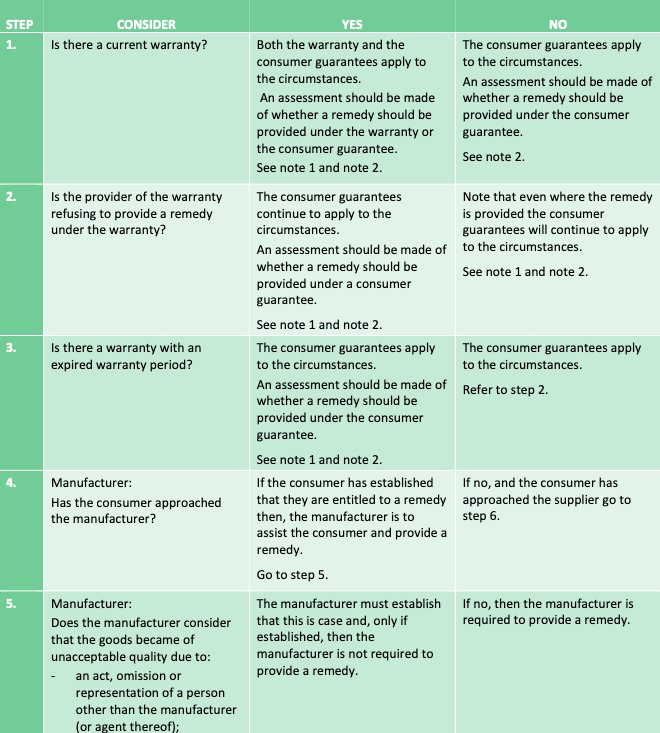
At the same time, if the consumer approaches the manufacturer for assistance, and the manufacturer has an obligation under a consumer guarantee, then the manufacturer should assist the consumer. This is further clarified in the table provided below.
Where the supplier of goods has an obligation under the consumer guarantee, then the supplier should assist the consumer and not redirect the consumer to the manufacturer. Also, the supplier may assist the consumer with a claim under a manufacturer’s warranty. However, if the consumer is not satisfied with this and/or asks the supplier to provide the remedy, then the supplier has an obligation to provide a remedy. On a practical level, the supplier may need to send a good away to assess whether the consumer is eligible for a remedy. However, as the supplier has obligations under the ACL that are separate to the manufacturer’s obligations and the supplier has a right of indemnity against the manufacture in some circumstances, it is inappropriate for a manufacturer to require a supplier to obtain approval to provide a remedy to a consumer or for the supplier to seek such approval from the manufacturer. Your words should also reflect these actions so that it is important not to use words to the effect that you will ‘seek the approval of the manufacturer’ or ‘find out from the manufacturer whether you can provide a remedy’.
Indemnity
The supplier has a right of indemnity against the manufacturer under the ACL where the supplier has incurred costs in relation to the failure to meet the following consumer guarantees:
-
the consumer guarantee as to acceptable quality (ACL section 54);
-
the consumer guarantee as to fitness for a disclosed purpose, which is made known by the consumer to
the manufacturer either directly or through the supplier (ACL section 55);
-
the consumer guarantee in relation to the description applied to the product by or on behalf of the
manufacturer (or with the express or implied consent of the manufacturer) (ACL section 56).
In certain circumstances, the supplier also has a right of indemnity against the manufacturer if the supplier is liable for loss or damage in relation to particular consumer guarantees.
If the supplier seeks to enforce the right of indemnity against the manufacturer the supplier must do so within three years of the earlier of the first day of the discharge of the liability or the day on which the consumer commenced proceedings against the supplier.
Who is a Manufacturer?
The definition of manufacturer under the ACL is quite broad and may encompass suppliers who are not aware they fall within the definition for the purpose of the ACL. Under the ACL a person or entity will be a manufacturer if any of the following circumstances applies to the person or entity, the person or entity:
-
assembles, processes, produces, extracts or grows the good;
-
holds themselves out to the public as the manufacturer of the good or allows another person/entity
(supplying or promoting the supply of the good) to hold them out as the manufacturer of the good;
-
allows their name to be placed on the good, including the name of the business or trademark of the
person or business; or
-
imports the good into Australia where the person/entity is not the manufacturer of the good and, when
the goods are imported, the manufacturer of the goods does not have a place of business in Australia (in relation to this, if the goods are imported on behalf of a person/entity, the person/entity is taken to have imported the good).
It is important to note that more than one person can be identified as the manufacturer of a product (the actual or deemed manufacturer), in which event the manufacturers will both be liable as the manufacturer under the ACL.
Obligations of Suppliers and Manufacturers
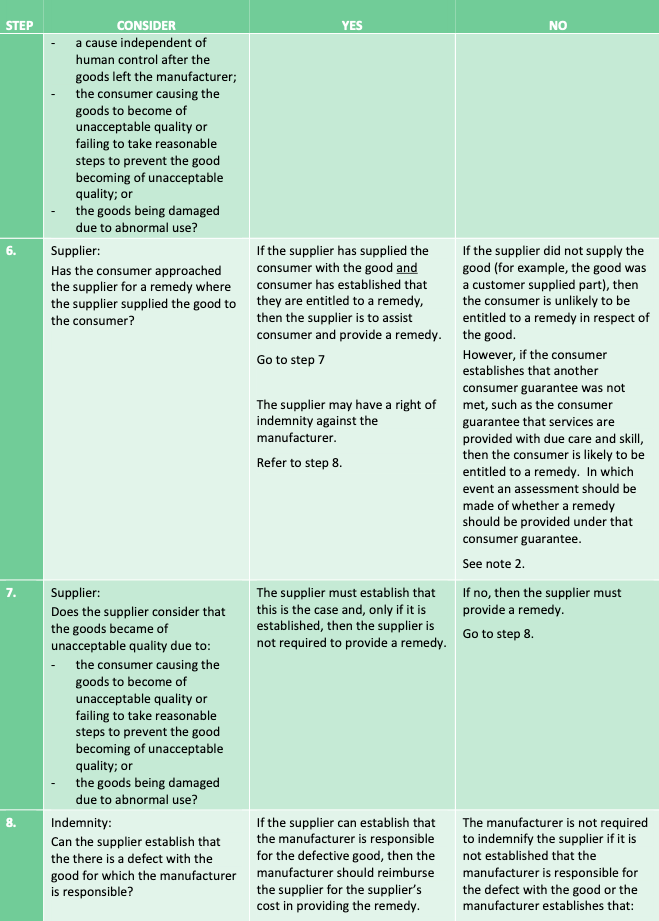
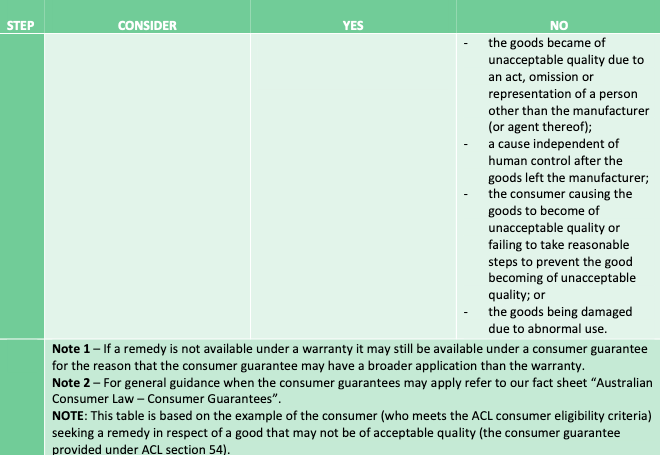
The following table assists to identify who is responsible for providing a remedy to a consumer and when the supplier’s right of indemnity against the manufacturer may apply. The table is based on the example of the consumer (who meets the ACL consumer eligibility criteria) seeking a remedy in respect of a good that may not be of acceptable quality (the consumer guarantee provided under ACL section 54).
Need assistance?
Industry Legal Group provides members with information and advice on consumer law matters, including assistance addressing consumer guarantee issues. Assistance extending beyond general advice will be charged on a fee for service basis and we will provide you with a fee estimate on request or within a general advice provided to you. AAAA members have access to a discounted rate for our services. Please contact Industry Legal Group on 1300 369 703 or aaaa@industrylegalgroup.com.au if you have any questions relating to this fact sheet or to discuss any consumer law issues that arise.
Industry Legal Group Pty Ltd
This fact sheet is intended for information purposes only and should not be regarded as legal advice. Please contact Industry Legal Group on 1300 369 703 or aaaa@industrylegalgroup.com.au for legal advice before taking any action.
Individual liability limited by a scheme approved under Professional Standards Legislation.
3448-7049-6014, v. 1
Comments
0 comments
Article is closed for comments.