
Australian Consumer Law (ACL) requires businesses (suppliers and manufactures) to provide consumers with certain guarantees for goods and service. However, consumer rights are not limitless, and consumers are not always entitled to return goods or terminate services. This fact sheet general information the application of Consumer Guarantees and when a remedy may be provided.
Consumer Guarantees
Under the ACL, there are guarantees which apply to the supply of goods and services to consumers (Consumer Guarantees). Consumer Guarantees include, for example:
-
The supplier guarantees they have the right to sell the goods;
-
The supplier and manufacturer guarantees the goods are of acceptable quality;
-
The supplier guarantees the goods are fit for any disclosed purpose;
-
The supplier and manufacturer guarantees the goods match their description;
-
The supplier guarantees the goods correspond with the sample or demo model;
-
The manufacturer takes reasonable action to ensure that facilities for the repair of the goods, and parts for the goods, are reasonably available for a reasonable period after the goods are supplied unless otherwise agreed;
-
If applicable, the supplier and manufacturer guarantees they will comply with any express warranty made in relation to the goods;
-
The supplier guarantees the services will be rendered with due care and skill;
-
The supplier guarantees the services will be fit for a particular or disclosed purpose; and
-
The supplier guarantees the services will be supplied within a reasonable time.
Meaning of Consumer
A consumer is defined in the ACL as a person who acquires goods and services for $40,000 or less, or for personal, domestic or household use or consumption, or, for goods, for a vehicle or trailer acquired for use principally in the transport of goods on public roads. A person is not considered to be a consumer of goods if they acquire goods for re-supply, to use or transform as part of a business in a process of production or manufacture, or repairing or treating other goods.
A business who purchases goods or services that meets the eligibility criteria of consumer, is also a consumer for the purpose of the ACL and can benefit from the consumer guarantees.
Failure to Meet a Consumer Guarantee
If the supplier of a good or service fails to meet a consumer guarantee, then the consumer will be entitled to a remedy. The types of remedy the consumer will be entitled to will depend on whether the failure to meet the consumer guarantee is a major failure or not.
What is a major failure?
As a general overview a failure to meet a consumer guarantee will be a major failure if one of the following
conditions are met:
- the goods or services would not have been acquired by a seasonal consumer fully acquainted with the nature and extent of the failure;
- the goods or services are substantially unfit for the purpose for which goods or services of the same kind are commonly supplied, or for a purpose that was made known by the consumer, and they cannot be remedied within a reasonable amount of time to make them fit for such a purpose;
- the goods are unsafe or the services create an unsafe situation;
- the goods significantly depart from the description of the good or the demonstration model of the good (if the good was supplied by description or by demonstration); or
- the service, and a product resulting from a service, is not of the nature, quality, state or condition, that might reasonably be expected to be achieved where the desired result was made known by the consumer, and the services and product cannot easily be remedied within a reasonable time to achieve the desired result.
Available Remedies
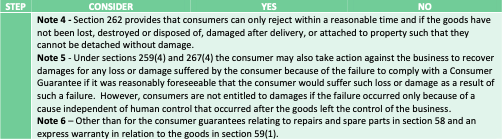
Under the ACL, consumers have a right to ask for a repair, replacement, refund or other remedy if a business has failed to satisfy its obligations in relation to the Consumer Guarantees (see below for details on the remedies available to consumers depending on whether the failure to comply is a major failure or not). Further, a consumer may also be able to seek damages for reasonably foreseeable loss or damage for the failure to meet a consumer guarantee. If the consumer is eligible to receive a remedy, then the remedy should be provided within a reasonable time.
Not a major failure:
For goods:
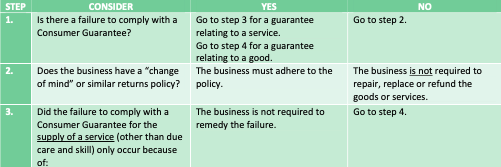
If the failure to meet a consumer guarantee relating to goods is not a major failure, then the business supplying the good can provide a remedy by repairing the goods, replacing the goods with goods of an identical type or refunding the money paid by the consumer, within a reasonable amount of time (consumer guarantees relating to title in the goods have different remedy requirements) (Also refer to row 5 of the table below for further details).
For services:
If the failure to meet a consumer guarantee relating to services is not a major failure, then the business supplying the service can provide a remedy within a reasonable amount of time (for example, repairing a part or installing a replacement part) (Refer to row 5 of the table below for further details).
Major failure or remedies not provided within a reasonable amount of time:
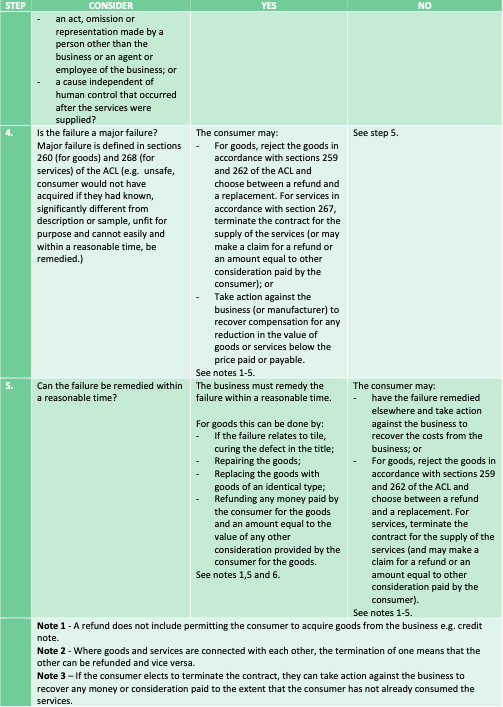
Where the failure to meet a consumer guarantee is a major failure, a remedy was not provided to the consumer within a reasonable amount of time or the failure cannot be remedied, then the consumer has access to further types of remedies. The remedies available in these circumstances for goods and services are as follows:
For goods:
The consumer can either reject the goods or make a claim to recover compensation for the reduction in the value of goods (below the price paid or payable for the goods).
If the consumer rejects the goods then the consumer, at the consumer’s choice, can have a refund or opt to receive a replacement, however, the consumer must return the goods to the supplier (unless the goods cannot be returned without significant cost to the consumer due to the size, height or way in which the goods have been attached (the supplier must then collect the goods at the suppliers expense)). Additionally, the consumer may not reject the goods if the goods are lost, destroyed or disposed of by the consumer, damaged after delivery (not related to the consumer guarantee), attached to property so that the goods cannot be removed without damaging the goods, or the rejection period has past (meaning the reasonable amount of time for that type of product to present a failure to meet with a consumer guarantee has passed (this amount of time will depend on the type of good)).
For services:
The consumer can either terminate the contract for services or make a claim to recover compensation for the reduction in the value of services (below the price paid or payable for the goods).
If the consumer terminates the services, then the consumer is entitled to a refund for the services (to the extent that the consumer has not consumed the services). Further, if goods were supplied in connection with the services, then the consumer is considered to have rejected those goods if the contract for services is terminated, and the consumer must return those goods to the supplier (unless the goods cannot be returned without significant cost to the consumer due to the size, height or way in which the goods have been attached (the supplier must then collect the goods at the suppliers expense)) and the supplier must refund the consumer for the goods (note, where a part is installed as part of a service and it is either repaired or otherwise remains in the vehicle, then arguably the good is not rejected and a refund would not need to be supplied).
Indemnity against the manufacturer:
If the consumer seeks a remedy and/or damages from the business who supplied the goods, then, in some circumstances, the business will be entitled to be indemnified by the manufacturer for its costs in remedying the issue (For more information regarding the supplier’s right of indemnity please refer to our fact sheet “Australian Consumer Law – Supplier and Manufacturer Obligations”).
Remedies not available in every circumstance:
It is important to note that consumers are not entitled to a remedy in every circumstance. For example, businesses are not obligated to offer a remedy under the ACL where the consumer simply changes their mind. However, for various reasons some businesses have a “change of mind” policy which allows consumers to return goods under certain terms if they change their mind. If this is the case, the business must abide by the policy.
Rights and Responsibilities
The following table provides a guide on the availability of a repair, replacement, refund or other remedy for goods or services.
Responsibility for Showing Failure to meet a Consumer Guarantee
It is the responsibility of the person asserting the failure to meet the Consumer Guarantee (or a defence against the failure to meet a Consumer Guarantee), to show or prove that the guarantee has not been met.
This means that if the consumer asserts, for example, that the guarantee as to acceptable quality has not been met then the consumer will need to show this. On a practical level the supplier (or manufacturer) may look at the good, note that the guarantee has not been met and provide a remedy to the consumer. However, if this is not the case then the consumer will need to show that there is a failure to meet the consumer guarantee. This may require the consumer to request an independent person or expert in the relevant area to examine the good or service and provide a report.
If the supplier (or manufacturer) asserts a defence, for example that goods became of unacceptable quality due to abnormal use or due to the consumer causing them to become of unacceptable quality or failing to take reasonable steps to prevent the goods becoming of unacceptable quality, then the supplier (or manufacturer) will need to show this.
Need assistance?
Industry Legal Group provide members with information and advice on consumer law matters, including assistance addressing consumer guarantee issues. Assistance extending beyond general advice will be charged on a fee for service basis and we will provide you with a fee estimate on request or within a general advice provided to you. AAAA members have access to a discounted rate for our services. Please contact Industry Legal Group on 1300 369 703 or aaaa@industrylegalgroup.com.au if you have any questions relating to this fact sheet or to discuss any consumer law issues that arise.
Industry Legal Group Pty Ltd
This fact sheet is intended for information purposes only and should not be regarded as legal advice. Please contact Industry Legal Group on 1300 369 703 or aaaa@industrylegalgroup.com.au for legal advice before taking any action.
Individual liability limited by a scheme approved under Professional Standards Legislation.
3454-4995-8414, v. 3
Comments
0 comments
Article is closed for comments.